
FREE SCIENTIFIC POSTER
Synthetic DNA for Personalized Cancer Vaccines
From neoantigen to patient dose in as little as 21 days
The hard part of a personalized cancer vaccine isn’t picking the neoantigens anymore. It’s making a new batch of GMP DNA for every patient, fast enough to matter. This poster follows one 20-neoantigen cassette through a fully cell-free process — synthetic template, IVT, LNP encapsulation, and the tumor protection that followed..
21 days
neoantigen cassette to shipped PCV batch
180 bp
polyA encoded directly, no recombination
6 of 7
animals tumor-free after M20 mRNA-LNP
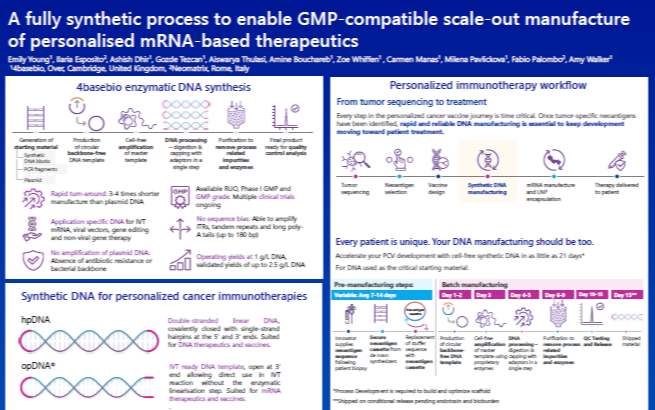
A fully synthetic process to enable GMP-compatible scale-out manufacture of personalized mRNA-based therapeutics
Presented at the mRNA Health Conference 2026
4basebio, Cambridge UK · Neomatrix, Rome
THE SHORT VERSION
Built for batch-of-one problem
A PCV program needs a new DNA batch per patient, on a clock, at GMP. Plasmid processes answer that with bacterial fermentation, a linearization step and poly(A) tails that recombine. opDNA® is a linear, IVT-ready template built cell-free and enzymatically. This poster takes it all the way to tumor protection in a 20-neoantigen model, with Neomatrix.
21
days to a PCV batch
The full pre-manufacturing and batch timeline, from neoantigen cassette through QC testing and release.
180 bp
polyA encoded directly
Long homopolymeric tails with no recombination, with CGE, IP-RP LC-HRMS and LC-MS/MS characterization included.
6/7
animals tumour-free
Prophylactic MC38 study with M20 mRNA-LNP: 100% survival and a strong CD8+ T-cell response.
2.5 g/L
validated DNA yields
Operating yields at 1 g/L and validated to 2.5 g/L, with manufacture 3–4× faster than plasmid
WHAT’S INSIDE
What the poster covers

opDNA® vs plasmid as an IVT template
IVT yield at matched template input, dsRNA impurity by dot blot across construct sizes, and what removing the linearization step changes.
Two synthetic formats, open at the 3′ end for direct use in IVT or covalently closed with hairpins, and which applications each suits.
What opDNA® and hpDNA are
Cell-free amplification, circular backbone-free template, single-step digestion and capping, purification and release — with no plasmid amplification at any stage.
The cell-free manufacturing process
Long poly(A) characterization
Tails to 180 bp encoded directly into the template, assessed by CGE, IP-RP LC-HRMS and LC-MS/MS for length and distribution.
What to expect from RUO through Phase I GMP and GMP, including the 21-day neoantigen batch timeline and 50 mg to multigram scale-out.
Grades, timelines and batch sizes
A 20-neoantigen MC38 cassette taken from opDNA® template through mRNA synthesis to LNP encapsulation, with prophylactic and therapeutic in vivo readouts.
An end-to-end PCV case study
Developed with Neomatrix, Rome. Presented at the mRNA Health Conference 2026.
FREE POSTER
Get the poster
opDNA® outperforms plasmid DNA at lower template input, with no linearization step — the poster shows the data.
The complete poster: every figure, the full manufacturing workflow and both in vivo studies.
Instant access to the PDF on submit
All figures, protocols and analytics data
No obligation, unsubscribe at any time