
Where it all began: The Story Behind 4basebio's Synthetic DNA Technology
Hear from scientific founder Professor Luis Blanco on how his discovery helped shape the technology behind 4basebio's synthetic DNA platform
Scientific breakthroughs are often remembered for the moment they change the world. What is less often remembered is the lifetime of curiosity, persistence and collaboration that makes those moments possible. The story behind 4basebio's synthetic DNA platform is one of those journeys. Long before enzymatic DNA synthesis became an important tool in biotechnology, its foundations were being developed through decades of research into one of biology's most remarkable processes: the replication of DNA. What began as an academic pursuit to understand the science behind DNA replication, evolved into a technology that is now shaping the future of genetic medicine.
Central to that scientific journey is Professor Luis Blanco, PhD, a scientist whose career has been defined by a deep fascination with DNA replication and the enzymes that make it possible. "My first contact with science was really very young," he recalls. "I was very much inspired by DNA and how DNA was replicated." That fascination led him towards DNA polymerases, the enzymes responsible for copying DNA, which he still describes today as "the DNA writers" and "the real protagonists of DNA replication." In 1984, during his doctoral research, Luis and his team discovered and characterised Phi29 DNA polymerase, an enzyme whose extraordinary properties would later make it one of biotechnology's most influential tools. At the time, however, the significance of the discovery lay not in its future applications, but in the opportunity, it offered to understand biology more deeply. "I immediately was interested in understanding not just how polymerases work in nature," he explains, "but using them as tools to fabricate, repair or produce DNA."
As is often the case in science, the importance of a discovery only became fully apparent with time. The principles that would eventually underpin TruePrime® emerged from years of continued investigation, but neither Luis nor his colleagues could yet foresee the breadth of their future applications. "The broader view of different applications was not appearing on day one," he admits. "As happens with many scientific discoveries, once you understand the system, other people normally have the vision." Among those people was Dr Angel Picher, who completed his PhD thesis under Dr. Blanco's supervision and later helped carry the work from the academic laboratory into its next phase.
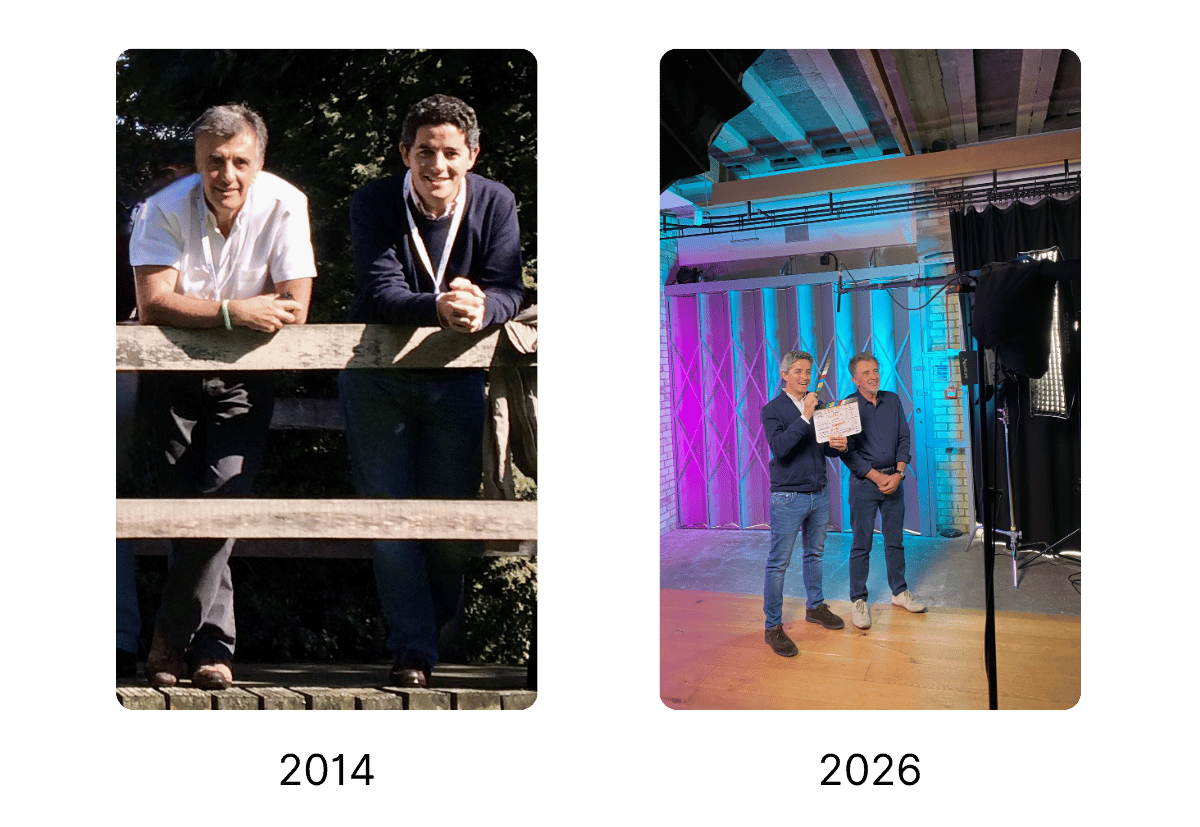
Professor Luis Blanco, PhD and Dr. Angel Picher In 2014 at the Robinson College in Cambridge, where we were attending a conference and presenting about DNA polymerases. Fast forward to 2026 visiting Cambridge again and telling us about the history of DNA polymerases.
Reflecting on the early years of the company, Angel remembers an organisation that looked very different from the 4basebio of today. "The story of 4basebio in Spain is actually quite long," he reflects. Founded by Luis in 2008, the company began as an effort to translate years of academic research into practical biotechnology. As the technology continued to evolve, so too did the team's understanding of where it could make the greatest impact. "At the time we discovered that there were unmet needs that we could potentially cover with the TruePrime® technology," Angel recalls. Existing approaches to DNA production relied heavily on plasmids generated in bacterial systems, introducing bacterial sequences and antibiotic resistance genes that were not always desirable for emerging therapeutic applications. "We started to develop enzymatic tools before and after the amplification reaction," Angel explains, "to be able to produce larger-scale DNA and also format that DNA into the shape that the customer may need."
The platform that emerged was built upon decades of expertise in enzymology. For Angel, that understanding remains central to what makes 4basebio's approach distinctive. "At heart, we're enzymologists," he says. "The deep knowledge that people at 4basebio have regarding enzymes and enzymatic processes is critical. You need to understand how enzymes act in vivo and how you can adapt them to your needs." That philosophy continues to shape the company's work today, combining a deep understanding of biology with the practical challenges of producing synthetic DNA for an evolving field of genetic medicine.
Looking back across more than four decades of research, Luis believes the field has undergone a profound transformation. "At the beginning all the focus was on DNA sequencing," he reflects. "The idea was just reading the DNA." Today, he sees a very different landscape. "It's not just reading the DNA, it's fabricating DNA." For Luis, the ability to produce high-quality synthetic DNA on demand marks a new chapter for biotechnology, one that will underpin advances in vaccines, genome editing and synthetic biology for years to come.
Yet when asked what gives him the greatest satisfaction, Luis does not speak first about technology. Instead, he reflects on the journey itself. "I'm not happy because the idea was a commercial success," he says. "It's more to do with the journey from a fundamental observation in science that, with the help of many people, was converted into products that can help solve problems." More than any individual achievement, he believes the true legacy lies in the people who carried those ideas forward. "The most important thing for me is the people," he says. "One person can't do it all. It's important, the continuation, the legacy."
That sentiment perhaps best captures the story behind 4basebio's synthetic DNA platform. It is the culmination of decades of scientific curiosity, collaboration and perseverance, built upon discoveries that began in the laboratory and continue to evolve through the work of those who followed. The technology may continue to advance, but the principles that inspired its beginnings, a desire to understand biology and to apply that understanding for the benefit of others, remain unchanged.
Discover more blogs from 4basebio:


